
Video games can be an immersive experience. With great sound design and memorable music, they can affect the player in many ways and the feeling of ‘’being there’’ can be tense. In this essay I’m going to analyze sound and music in puzzle game Portal and investigate, how diegetic and nondiegetic sounds are used in the game in question.
According to James Buhler, David Neumeyer and Rob Deemer, diegetic sound means every single piece of music and sounds that the character can hear in the reality of the movie, or in this case, game. Non-diegetic on the other hand means the sounds and music that the audience (player) hears. (2010). In Portal, to examine these concepts is very interesting, as the audience – the player – takes a bigger role than just viewing the story, as they are actively taking part to it and sometimes even creating new events.
Portal in a nutshell
Portal is a video game developed and published by Valve Corporation (former known as Valve Software) for Microsoft Windows, Playstation 3 and Xbox 360 in 2007. Later it has been released also on mobile platform Android and on other computer operating systems like Linux and OS X. The main focus in the game is solving portal-based puzzles while A.I. (Artificial Intelligence) voice tells you sarcastic jokes and guides you through the game. Player spends most of the time in ‘’test chambers’’, which are located on the research station called Aperture Science. As I don’t want to spoil the game more than it’s necessary to analyze the music and sounds, I’m not going to discuss about story much more. Game is pretty short, it took me about one hour and thirty minutes to play it, and according to speedrun.com, the current world-record on completing the game is seven minutes (2017). Of course, the whole idea of the speed run scene is to complete games as fast as possible, but I still find that worth to mention.
There are two shown characters in the game: Chell, player’s character, who doesn’t speak a word during the gameplay, and GLaDOS, a computer A.I. voiced by Ellen McLain. There are also hints of other characters, but all that’s shown of them are only writings that they’ve left behind.
Soundtrack
Portal’s soundtrack is composed by Kelly Bailey and Mike Morasky. While the music is mostly dark ambient and instrumental, it includes also one song called ‘’Still Alive’’, composed by Jonathan Coulton and sung by Ellen McLain. I’m going to return to this particular song later on this essay. Soundtrack is released outside the game three times, first on Valve’s own collection called The Orange Box Collection (Valve, 2009), which includes various soundtracks from their games. In 2014 Valve released the soundtrack for free on their digital distribution platform Steam, and now the soundtrack has been released on the vinyl by Mondo in 2017. It’s also been released on a massive collection by Ipecac Recordings on music distribution service Spotify including also its sequel’s, Portal 2 (2011), soundtrack.
Game’s soundtrack is mostly minimalistic, electronic ambient score music. Score music is term for the music, that’s made specifically for the movie or game (Chion, 1994). It’s creating mood of being alone in the giant, weird research station, and in some ways, it reminds of horror movie music. During the main events music takes turn to more energetic and ‘’heart-pounding’’ style, being almost like trance or some other similar electronic music genre. This happens only few times during the game, so it really makes the mood and atmosphere change during the twisted story events. This kind of music is sometimes called as adaptive music (Timms, 2016).
Diegetic sounds in Portal
Player’s character, Chell, can hear many different sounds in the game’s world. There are lots of mechanical noises made by different apparatus in the test chambers, for example elevators and electric barriers. She’s also able to hear the GLaDOS through speakers, even though it might feel like the A.I. speaks inside of her head. This impression is broke during the last section of the game, where it’s clear that GLaDOS is speaking through bad quality speakers outside the chambers. Chell can also hear turret’s speech, sometimes even not seeing them.
Most of the speech in the game comes somewhere outside of the Chell’s and players view. Later in the game Chell meets previously mentioned turrets, and eventually she’ll meet GLaDOS, getting to know the voice that she’s been hearing during her adventure. GLaDOS’ voice is de-acousmatized, as the source is revealed to the player character in the end of the game (Chion, 1994), and it’s not possible to tell during most of the story where her voice is coming from.
There is also some diegetic music in the game, and it can be heard already in the beginning of the game. Music is played through little radios, that are scattered throughout the test chambers, and they play instrumental Latin styled version of the credit song, ‘’Still Alive’’. The familiar tune becomes somewhat relaxing and welcoming little thing during the game.
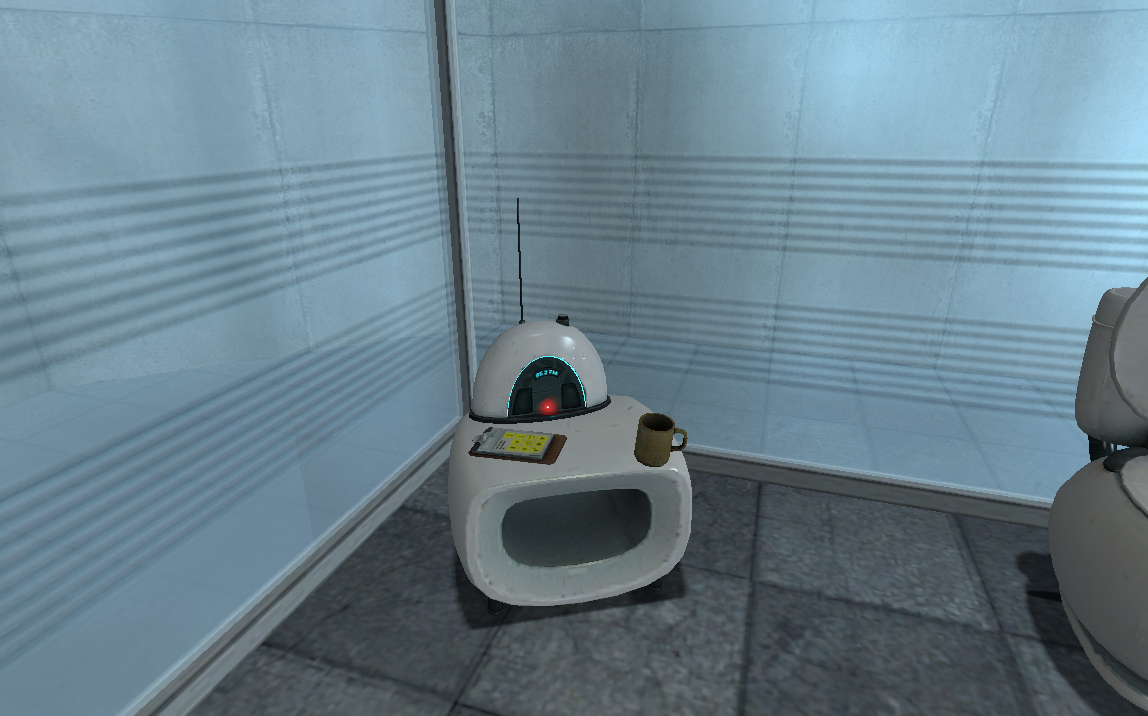 |
First radio you’ll encounter during the game. Source: <https://cdn.wikimg.net/en/strategywiki/images/8/89/Portal_Radio_1_start.png> |
Non-diegetic sounds in Portal
For the player, there’s lots of sounds that the played character can’t hear but player can. One example is the click-sound played when you press one button. It’s meant to demonstrate to the player, that they can or can’t interact with some objects. As the sound is familiar from the many other Valve’s games, it’s pretty safe to assume that it’s part of the game engine and not something that characters can hear in their minds.
The ambient music is only heard by player, as it’s not the part of the reality of the game and is more or less just there to create the mood. Music is sometimes almost non-audible, and it’s possible to think that it is part of the world’s atmosphere. We are speaking of imaginary environment, so of course it’s possible that the ambient music can be there in the world, but as the game is trying to be somewhat realistic I don’t think that’s the case.
Player as a character
Games differ from the films as in games you are (mostly) in control of the one or more characters related to the story. That creates an interesting dilemma whether or not the sounds you hear as a player are also sounds that your character hears. You are the character, so your ears are theirs too. When speaking of the sounds and music, this goes sometimes to very weird places. How can you know that your character isn’t wearing earphones and listening the ‘’soundtrack’’ while going through the game world as playing in the first person view (FPS) doesn’t traditionally let you see characters head?
Of course, we can assume that’s not the case, as we take many games as some kind of interactive form of movies. Still, it’s worth to mention, that in games player takes a bigger role than being just neutral viewer. Because of this, it’s sometimes hard to recall which sounds are diegetic and which ones are non-diegetic. Player takes a role of actor in some way, but with more ways to affect to the what’s happening on the screen. But as Portal is very linear game, and if you play it like it’s meant to be played, everything important to the story happens eventually. You can for example stay at the same place or refuse to do something, which actors probably can’t do if they want to get their salary. You have even the possibility to exit the story and never come back, but where’s the fun in that?
‘’Still Alive’’, the diegetic and non-diegetic song
The credit song of the game, ‘’Still Alive’’, exists in both game’s reality and our reality. In the game, it’s played on the radios that can be found almost on every level, and the distorted, Latin styled instrumental version can be heard. Song is also played at the end of the game while credits are shown, and you even get the lyrics to sing along. Different versions of the song are released on many releases, and there are at least two different sung versions on Valve’s official music releases.
Song itself is sung by Ellen McLain, the voice of GLaDOS, and the vocals are edited at the same way as the A.I.s voice. Lyrics are based on the game, and there are little notes of the story events and even hints of other Valve game, Half-Life. The lyrical and vocal aspect makes song very interesting as it’s supposedly something from the game’s world, but it’s existing in our reality, as normally this goes other way: we’ll take some pre-existing song from real life and put it on reality the game or movie, as a source music (Chion, 1994). In the case of ‘’Still Alive’’, we get something that’s not real, but instead it’s made real for us through playing the game and ‘’living’’ the story.
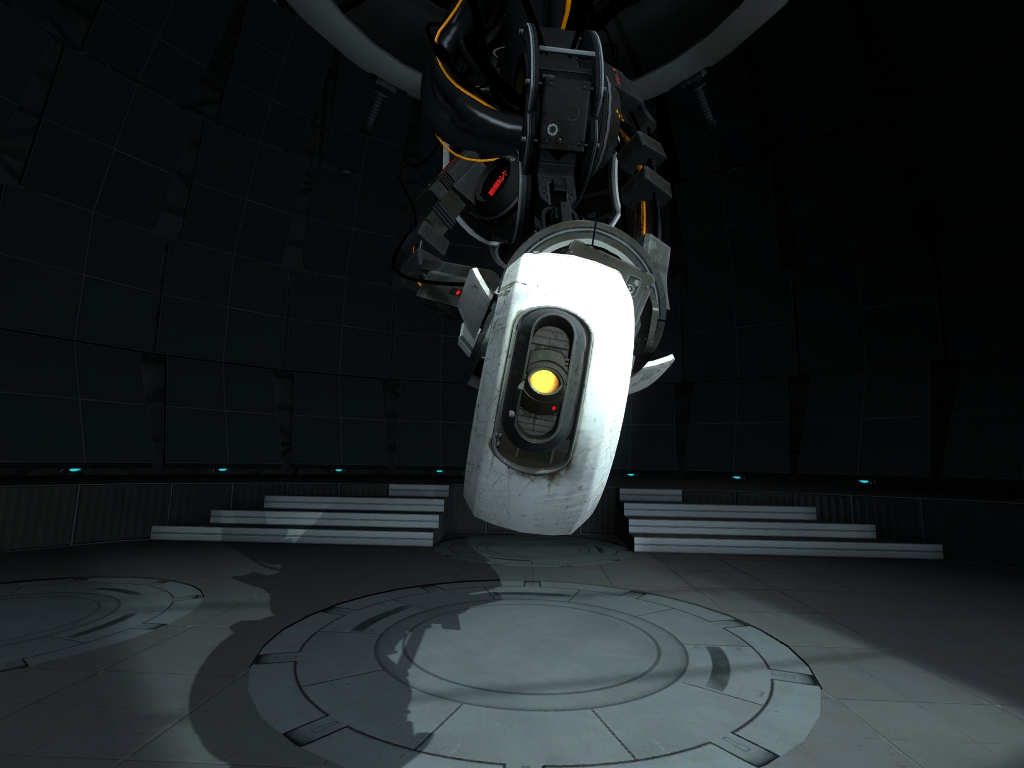 |
| GLaDOS. Source: https://theportalwiki.com/wiki/File:Glados_ending_monologue.jpg |
Conclusions
Portal includes a lot of diegetic sounds, but as many games, it’s playing also with non-diegetic and blurring player’s and playable character’s borders. At the same time it’s easy to say, which sounds belong to the game’s reality, but then again, you can never be sure if some clicks or beeps that feels like part of the game mechanics would be real sounds in the world you are playing on.
Game’s sound design leaves al lot of room for player’s own imagination, as even the sound of keyboard feels something that could be part of the fame. Soundtrack is almost a part of the world, and even in the real world ambient voices you hear can be somehow musical. At the same time you know, that the soundtrack is something that doesn’t belong to game’s reality, but the border between ‘’real’’ ambient in the game and music is very thin and blurred.
The whole idea of Portal-series is to play with reality, as Valve’s been releasing a lot of videos and other material based on the game and its story. These little things are made so that they feel like being part of our world, and Valve is sometimes even advertising their own services using characters or places from the Portal-universe.
References
1. Research material
Aperture Science Psychoacoustic Laboratories 2012. Portal 2: Songs to Test By (Collector’s Edition) [Spotify]. Ipecac Recordings.
Valve Corporation 2007. Portal [PC]. Valve Corporation.
2. Internet-references
Speedrun 2017. Continuously updated speed run record collection and list for Portal and other games. <https://www.speedrun.com/Portal> (read 5.12.2017)
3. Literature
Buhler, James, David Neumeyer and Rob Deemer 2010. Hearing the Movies: Music and Sound in Film History. New York: Oxford University Press.
Chion, Michel 1994. Audio-vision: sound on screen. New York: Columbia University Press.
Timms, Mark 2016. How sound design is used to create a sense of tension and horror in video games. Academia.
<https://www.academia.edu/24424213/How_sound_design_is_used_to_create_a_sense_of_tension_and_horror_in_video_games> (read 7.12.2017)
Note: I wrote this essay in 2017 for my musicology studies in University of Turku. I wouldn't recommend using it in academic context.


